

“When diet is wrong, medicine is of no use; when diet is correct, medicine is of no need.”
You must have already heard about this Ayurvedic proverb that trulyn exemplifies the importance of having nutritious food as part of a healthy lifestyle.
And we have been hearing this established statement repeatedly, so much so, that it has become a cliché now. But perhaps, cliches are cliches because they are often undeniably true.
Ayurveda places a pivotal importance on food as being central to our wellbeing. Making conscious food choices based on your particular dosha (body and mind energy type) ensures that your doshas are balanced and your body, mind, and soul are at peace.
But what about the dual Prakriti of the Kapha-Pitta type, where opposite elements of fire and water co-exist? What should the diet of this dual prakriti look like?
Before diving deep into the answers, let’s first understand:
What is Kapha-Pitta Prakriti type?
Kapha-Pitta Prakriti type is a Kapha-dominated Prakriti, and true to its complex-sounding name, it does pose a unique challenge to the person having this dual Prakriti.1
Read more: Ayurveda Basics: Qualities of Kapha
The primary dosha (Kapha) being dominated by the earth and water element antagonizes the fiery nature of the secondary dosha (Pitta) dominated by the fire and the water element.
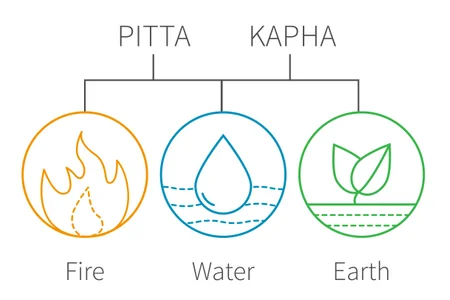
This might bud a question in your mind:
‘How can two contrasting elements of both fire and water coexist in Pitta?’
You might find it fascinating to know that water in this dosha represents fluidity. This enables the flow of substances that represent Pitta in the human body like enzymes and hydrochloric acid in the stomach.
On the other hand (you might find it interesting too) the water represented in the Kapha bestows predominantly cold, cohesive, and smooth qualities to Kapha.
At large, Kapha is a threat to the fiery nature of Pitta. You don’t want to increase the Kapha levels in the body to the point where they dampen the fiery nature of Pitta and in return affect the digestive fire or agni that is nurtured by Pitta.
Read more: 10 Ingredients to Cool Pitta | 10 Easy Ways To Get Rid of Pitta Skin Problems And Their Root Causes
So then, you can ask yourself:
‘Should I be eating two sumptuous meals or 5-6 small meals? Should I have cold foods like ice cream at all? Which grains are good for me?’
So many questions come to mind!
Kapha-Pitta Diet and Your Metabolism
What happens when Kapha and Pitta are in balance?
- It provides a cradle for the digestive enzymes and juices to act properly in the stomach and small intestine
- It also provides lubrication for the stools to be moved properly in the intestines
- It counters the acidic environment created by Pitta-dominated metabolites throughout the body and provides the buffering alkaline environment
What happens if Kapha gets aggravated?
If Kapha gets aggravated, it shifts the balance first to the alkaline side. As soon as it antagonizes the digestive fire and dampens it, the metabolism all over the body is hampered. The digestive fire is believed to ‘fuel’ the so-called ‘metabolic fires’ which are referred to as bhootagni and dhatwagni.
So, a weak digestive fire leads to the formation of many unwanted metabolites that in turn lead to the precipitation of many chronic disorders.
Read more: Perfumes + Scents: Stimulating Aromas For Kapha Dosha
What if Pitta gets aggravated?
Conversely to Kapha, the aggravation of Pitta tilts the balance towards an acidic state. It depletes Kapha and its protective actions which cause various kinds of excoriating and inflammatory disorders and disorders related to blood.
So, if your physiology is dominated by these two doshas – both important for metabolism, growth, and repair – you need to take care that your diet fulfills the requirements, does not aggravate either of the doshas, and keeps them both in balance.
All this can be done by simply listening to your body!
The aggravated dosha needs your attention, as the symptoms relating to both the doshas are completely different.
This is what you can do when:
- A dosha is aggravated- Have foods that have properties opposite to that of the dosha in question.
- A dosha is depleted- Have foods with the same properties as that of the particular dosha.
And what do you do to bring back balance to your body and mind? Tell us in the comments!

What if both of your constituent doshas are perfectly balanced?
Then all that you have to do is maintain that equilibrium!
How?
By developing THE perfect and personalized meal plan that caters to YOU and YOUR body only!
There is no one-size-fits-all approach in Ayurveda. It believes that a successful meal plan must cater to a particular individual in a personalized manner.
Here is an Ideal Meal Plan for the Kapha-Pitta Diet!
- Start your day with a glass of warm water and a platter of fruits, ten almonds, and ten raisins (soaked overnight in water).
- Breakfast could be a cereal like oats with low-fat milk. Bread made from barley flour, whole wheat, or multigrain flour can also be taken along with egg whites.
- In midmorning, a handful of roasted seeds like pumpkin, sunflower, or flax (flax seeds only in winter) can be taken with mint and tulsi tea or buttermilk before lunch.
- Lunch could be a mix of vegetables and whole grains like pearled barley, boiled bulgur wheat, quinoa, amaranth, or wild rice. The protein portion can come from white meats, green moong beans, and red lentils.
Lunch can include cooked salad like sauteed cabbage and carrot julienne. Any other type of vegetable is also good to have.
- In the early evening, a serving of fruit can be taken along with herbal tea.
- Dinner can be the same as lunch but should be smaller in quantity and taken before 8 pm if possible.
Dinner can include soup or vegetarian stew. Experiment with dishes like modified cabbage rolls having fillings like cooked grains or moong beans sautéed in olive oil.
You may have a glass of warm saffron milk or turmeric milk before going to bed. Use low-fat cow’s milk or soy milk.
Read more: Pitta And Kapha Pacifying Cruciferous Vegetables Soup (Perfect For Weight Loss) | Pitta diet for the summer season
Please consult a qualified Ayurvedic practitioner before following the dietary recommendations for a Kapha-Pitta diet mentioned in this article.
Restore your health in the holistic Ayurvedic way that has been in use for over 5000 years. These ayurvedic diets have been followed by millions for millenniums!
Incorporate the tried and tested Ayurvedic diet tips according to your dosha, for a holistic approach to healthy eating and discover your healthiest self!
Click here to read the next part of the blog for a custom meal plan for a Kapha-Pitta person
Do you believe in following a specific meal for your own body type? What does your food plate throughout the day look like? Share with us in the comments!





0 Comments