

The Ayurvedic concept of holistic healing is a traditional system of natural healing that dates back over 5,000 years. Rooted in India’s Vedic culture, it offers a holistic approach to health, aiming to create balance in the body, mind, and spirit.
The word Ayurveda comes from Sanskrit:
- “Ayus” means life.
- “Veda” means knowledge or science.
Together, Ayurveda translates to “The Science of Life.” Unlike modern medicine, which primarily focuses on treating diseases, the Ayurvedic concept of living is a way of life that helps maintain good health, prevent illnesses, and support overall well-being.
What is Ayurveda: Understanding Core Principles
Ayurveda is based on a few key concepts that set it apart from other health systems:
Personalized Health & The Doshas
One of Ayurveda’s fundamental principles is that each person is unique. Your body, mind, and health are influenced by your Prakriti—your natural constitution, which is determined at birth.
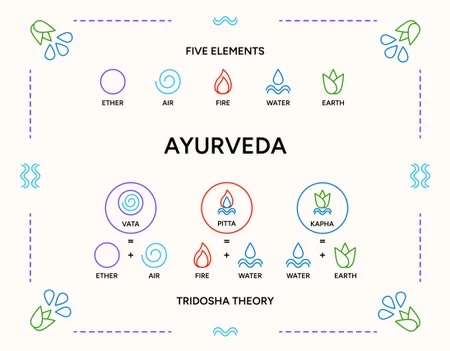
Ayurveda classifies people into three doshas—biological energies derived from nature’s five elements:
- Vata (Air & Ether): Governs movement, creativity, and flexibility.
- Pitta (Fire & Water): Controls digestion, metabolism, and energy.
- Kapha (Earth & Water): Provides structure, stability, and nourishment.
Each person has a unique mix of these Ayurveda doshas, and maintaining their balance is essential for good health. Each individual has a unique constitution, known as their Prakriti, which is made up of a combination of these doshas. There are seven possible Ayurveda dosha types, each with its own characteristics and significance. These are as follows:
- Vata Type
- Pitta Type
- Kapha Type
- Vata-Pitta Type
- Pitta-Kapha Type
- Vata-Kapha Type
- Tridoshic
ADVERTISEMENT
A Holistic Perspective on Health
Ayurveda looks at the whole person, not just symptoms. It considers your body, emotions, thoughts, and environment to determine what’s best for your well-being.
Prevention Over Cure in Ayurveda
Rather than waiting for illness to appear, Ayurveda emphasizes preventative care through a balanced diet, a daily routine, herbal remedies, and mindfulness practices.
Ayurvedic Concept of Healing Through Nature
Ayurveda relies on natural methods like food, herbs, yoga, meditation, and detoxification to restore balance. Unlike quick-fix solutions, its approach is gradual and long-lasting.
How Ayurveda Helps You Stay Healthy?
The Ayurvedic concept of life provides simple, practical tools to maintain good health and bodily balance. Here are a few principles that Ayurveda urges you to incorporate in your mindset and life:
- Eating According to Your Dosha – Choosing the right foods for your body type
- Following a Daily Routine (Dinacharya) – Aligning your habits with nature’s cycles
- Practicing Mindfulness – Meditation, yoga, and breathwork to calm the mind
- Detoxification & Cleansing – Panchakarma therapy to eliminate toxins from the body
- Using Herbal Remedies – Supporting health with natural plant-based formulations
- Massages & Self-Care Rituals – Strengthening the body with oil massages (Abhyanga)
If you’re unsure about your Dosha or current imbalances, an Ayurvedic consultation can help you create a personalized wellness plan suited to your needs.
The Spiritual Side of Ayurveda
The Ayurvedic concept of life doesn’t just focus on physical health—it also acknowledges the deeper connection between the body, mind, and spirit.
The Ancient Ayurvedic sages believed in two universal principles:
- Purusha (Spirit) – The unchanging, eternal essence of life.
- Prakruti (Nature) – The creative force that shapes your existence.
The interaction of these two forces gives rise to intelligence (Buddhi), which guides our thoughts and decisions. Over time, the ego (Ahamkara) develops, creating a sense of individuality. Ayurveda teaches that true healing happens when we reconnect with our inner wisdom and align with nature.
The Three Gunas: Understanding Mental & Emotional Balance
Ayurveda explains that everything in nature, including our minds, is influenced by three qualities or Gunas as referred to in ancient Ayurvedic texts:
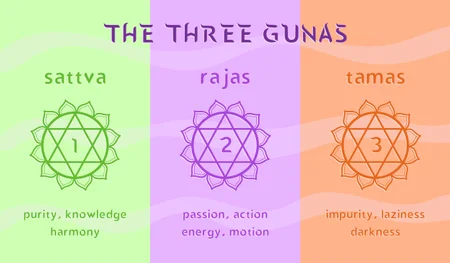
For a peaceful and healthy life, Ayurveda encourages increasing Sattva through a wholesome diet, meditation, positive thoughts, and ethical living. While Rajas and Tamas are also part of life, too much of them can lead to stress, anxiety, or dullness.
The Dosha Theory: An Ayurvedic Concept
Before the dosha emerges, the three Gunas of nature give rise to the five elements (Pancha Mahabhutas). Sattva gives the element of ether. Rajas gives fire. Tamas gives earth. Between Sattva and Rajas, the subtle but mobile element of air arises. Between Rajas and Tamas, the element of water arises.
These elements are the five states of matter: solid, liquid, radiant, gaseous, and ethereal. They represent the potential densities of any substance in the universe, as well as psycho-emotional states of mind and heart.
These five elements then combine to create the three different basic types of human constitution (doshas).
- Ether + air is Vata.
- Fire + an aspect of water is Pitta.
- Water + earth is Kapha.
By the elements and doshas, Ayurveda determines the basic nature of different individuals and establishes a line of treatment unique to their needs.

How to Know Which Dosha are You?
The Ayurvedic concept of life explains that one’s individual constitution is determined at birth and remains the same throughout life. The three general types of Ayurveda doshas are determined according to the predominant dosha, but other combinations and variations also exist. Two doshas may exist in equal strengths. The balance of doshas will show typical conditions and tendencies towards any excess.
What is Vata Dosha?
Vata can be recognized by its attributes: dry, cold, light, mobile, subtle, hard, rough, changeable, and clear. It is the most powerful of the doshas, being the life-force itself. It is the strongest force to create disease and governs all movement, carrying both Pitta and Kapha.
In its natural state, Vata is responsible for maintaining energy, breathing, movement, impulses, equilibrium, and sensual acuity. When it’s aggravated, it will cause dryness, dark discolorations, cold and tremors, abdominal distention, constipation, loss of strength, insomnia, loss of sensory acuity, incoherent speech and rambling, and fatigue.
Vata energy resides in the colon, hips, thighs, ears, bones, and the sense of touch. Its chief location is the colon where it accumulates and begins the disease process. From the colon, it can also be directly expelled from the body.

Constitutional Traits of Vata Dosha
People with a predominant Vata constitution tend to be physically underdeveloped, with a flat chest or prominent veins and tendons. Their complexion may be tinged brown with cold, rough, dry, or cracked skin. They will have few moles, if present and those will tend to be dark in color.
Vata people tend to be either tall or short, with thin frames, prominent joints, and low muscle development. Their hair is usually curly and scanty, and their eyelashes are thin. They have small active eyes that may look sunken or can lack luster, with a dry or dark conjunctiva. The nails may be brittle or rough, while the nose can be bent or upturned.
Their appetite and digestion are variable, sometimes one can easily eat a large meal or simply have no appetite at all. Vata people prefer warm food as well as drinks.
Their urine is scanty and dark, and their feces tend to be dry, hard, or small in quantity along with constipation. They don’t sweat much or easily. Additionally, their sleep is also light, short, and often disturbed. Their hands and feet are often cold.
Vatas are generally creative, active, alert, and restless. They talk fast, move fast, walk fast, and tire fast. They have a very quick understanding, but they come with a short memory and scattered attention. However, Vatas can be flexible and adjust quickly to situations. On the other hand, they may also be quite indecisive and impatient. Vatas need more endurance, confidence, and boldness. They think and worry too much and are afflicted with fear, anxiety, and nervousness most of the time.
Read More: Vata Diet: Everything You Need To Know
What is Pitta Dosha?
Pitta is recognized by its attributes: hot, light, fluid, subtle, sharp, malodorous, soft, and clear. It governs heat, temperature, and all chemical reactions in the body.
In its normal state, Pitta is responsible for digestion, heat, visual perception, hunger, thirst, luster of skin, intelligence, determination, courage, and softness of the body. When it is aggravated, there will be yellow discoloration of urine, feces, eyes, and skin, and may create hunger, thirst, burning, and difficulty in sleeping.
Pitta energy resides in the small intestine, stomach, sweat, sebum, blood, plasma, and the sense of sight. Its chief location is the small intestine where it accumulates and can also be directly expelled from the body.

Constitutional Traits of Pitta Dosha
Pitta people are usually of medium height, with moderate weight, frame, and muscle development. Their chests are not as flat as Vata-predominant people and reveal fewer veins and tendons. They also have less prominent bones, but many moles or freckles, which may be bluish or brownish-red in color.
Their complexion is coppery, yellowish, reddish, or fair. The skin feels soft and warm with fewer wrinkles than Vata dosha. It has some color to it and may appear flushed. The hair appears to be thin, silky, red or brownish and tends towards early graying or baldness. The eyes can be grey, green, or copper-brown in color with medium prominence and often poor vision. Their conjunctiva would be moist and may also have a copper color. The nails are soft in nature and the nose is sharp and reddish.
Pittas have a strong metabolism, appetite, and digestion, and can take a lot of food and drink. They enjoy things that are cool and refreshing and have a moderate sleep pattern, that’s less interrupted than Vata. Pitta people have yellow, soft, and plentiful feces, and sweat a lot. Their bodies are hot to touch; hands and feet are warm too. They don’t tolerate too much heat or sunlight.
They are intelligent and sharp, with good speaking and comprehension skills. However, Pitta-type people tend towards anger, jealousy, and even hatred, and can be ambitious leaders.
Read More: Pitta Diet: Everything You Need To Know
What is Kapha Dosha?
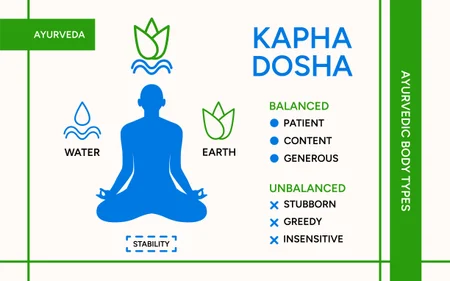
Kapha is recognized by its attributes: cold, wet, heavy, slow, dull, static, smooth, dense and cloudy. In its normal state, it is responsible for firmness and stability, maintenance of bodily fluids, lubrication of joints, and such positive emotions as peace, love, and forgiveness. When it is aggravated, there will be a loss of digestive power and an accumulation of phlegm and mucous. There will be a feeling of heaviness and exhaustion. There is pallor, cold, looseness of limbs, difficulty breathing, coughing, and excessive desire for sleep.
Kapha energy resides in the chest, throat, head, pancreas, ribs, stomach, plasma, fat, nose, and tongue in the body. Its chief location is the stomach. This is where it accumulates and causes disease and can be directly expelled from the body.
Constitutional Traits of Kapha Dosha
Kapha people usually have well-developed bodies but can tend to gain excess weight. They have broad expanded chests, and their skin is thick enough to hide the veins and tendons. Their bones are not prominent much and their muscles are well-developed.
Their complexion is most often fair, white, or pale. Skin tends to be soft, oily, moist, and cold. Hair is thick, dark, soft, and wavy. Their eyes are dense, black or blue in color, and the white is large and attractive. The conjunctiva is not red.
They have low steady appetites, slow digestion, and consume smaller amounts of food. They move slowly. Their stool is soft and pale and may evacuate slowly. Kaphas have moderate sweat, strong endurance, and good stamina. They sleep soundly and sometimes excessively and are often healthy and contented.
Kaphas tend to be tolerant, calm, forgiving, and loving. They can also be prone to greed, attachment, envy, and possessiveness. They have slow, but definite comprehension. It takes a long time to understand, and that knowledge is retained.
Read More: Kapha Body Type: Eating Right For Wellness And Vitality
The Ayurvedic Concept of Holistic Healing
Ayurveda, the ancient science of life, isn’t just about remedies—it’s a lifestyle that encourages harmony with nature. By understanding your unique constitution and making simple changes to your diet, habits, and mindset, you can create lasting health and vitality.
Whether you’re looking for ways to boost your energy, improve digestion, or reduce stress, Ayurveda offers timeless wisdom that can be easily integrated into your daily life.
Would you like to discover your Dosha and start your Ayurvedic journey? Share your thoughts in the comments!





0 Comments