

Ayurveda refers to tulsi as “the incomparable one,” “mother medicine of nature” and “the queen of herbs”. In this blog, we will take a look at all the tulsi benefits, uses, research and the perfect recipe to make a fresh tulsi tea.
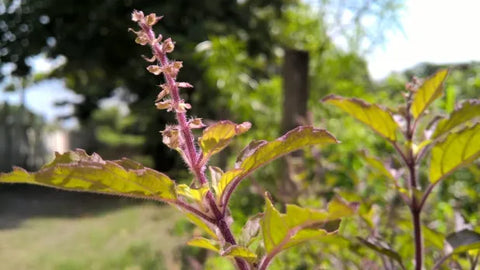
It is revered as an elixir of life for both its medicinal and spiritual properties. It belongs to the mint family and has two main varieties1. The greener variety is called ‘Rama tulsi’ and the purplish variety is called ‘Krishna tulsi’.
Holy basil or tulsi should not be confused with sweet basil, ocimum basilicum, which is commonly used for culinary purposes.
The importance of tulsi is indescribable to be honest. In Hinduism, tulsi is worshipped as a goddess and every part of the tulsi plant is revered and considered sacred, including the leaves, stem, flower, root, seeds, and oil.
Every Indian household has a tulsi plant, which is used for spiritual and religious practices.
Tulsi, like many other Ayurvedic herbs, is celebrated for its ability to balance the doshas and promote holistic well-being.
Fun Fact: Hundreds of thousands of tulsi plants have been planted around the Taj Mahal (India), one of the seven wonders of the world, to help protect the iconic marble building from environmental pollution and damage.2
Tulsi (Holy Basil) properties
Holy basil has a pungent, bitter taste, as well as light, dry, and sharp properties, and a hot potency.
Tulsi1,2 is considered as the earliest herbs known to humanity that took up the significant role of managing health concerns like common cold, headache, cough, flu, earache, fever, colic pain, sore throat, asthma, hepatic diseases, malaria fever, wound insomnia, arthritis, digestive disorder, night blindness and influenza. The intake of the leaves of tulsi may help enhance memory.
Amazing Benefits of Tulsi Herb
- Tulsi balances Kapha dosha
- It is anti-microbial and one of the most potent anti-viral herbs of Ayurveda.
- It improves taste and relieves a lack of appetite by stimulating the digestive fire due to its hot and sharp properties.
- It is a cardiac tonic and helps to relieve cholesterol deposits in the arteries due to its anti-Kapha and sharp properties.
- Due to its Kapha and Vata balancing effect, it is useful in the treatment of asthma and chronic respiratory disorders, cold and cough and also repeated hiccups.
- It relieves vomiting.
- Due to its Vata pacifying effect, it relieves gas accumulation.
- It is useful in skin diseases marked by itchiness due to its Kapha pacifying effect. Kapha dosha is responsible for itching in many skin diseases.
- It is a natural detoxifying herb.
- It is useful to treat kidney and bladder stones.
- It is useful to treat infectious eye disorders.
- It is an adaptogenic herb and is useful in stress-related disorders.
These were the overall benefits of the tulsi herb. Now, let’s get a bit specific to the skincare and haircare benefits of the tulsi herb.
Tulsi benefits for skin
It is antimicrobial and antiviral in nature and helps reduce itching.
Tulsi extract is used in cosmetics for its antibacterial activity. Classified as a fragrant and skin conditioning agent, it is used in anti-acne preparations3. Tulsi helps prevent the look of wrinkles as it contains ursolic4 acid. This compound further helps to retain elasticity in young faces. This very factor contributed to tulsi’s fame in the beauty and cosmetic industry and the very reason it is used in numerous face packs or face creams. Thus tulsi for skin is one of the best ingredients to naturally soothe, purify, and bring back a healthy glow.
Tulsi benefits for hair
Due to its Kapha and Vata pacifying properties, it is useful in combating dandruff, itching of the scalp, and the resultant hair loss. Holy basil helps in increasing hair luster. It also gives volume to hair and cures lice problem4.
You can see the number of benefits of tulsi herb — it’s clear why the benefits of tulsi are valued so highly in both traditional and modern wellness practices.

How to add Tulsi to your lifestyle
Here’s how you can use the holy basil5:
Part used: Leaf, Root, and Seed
Dosage: Fresh Juice 5-10 ml, Root decoction 50-100 ml, Seed powder 3 g. Extract 300mg-2000 mg. Please note, the extract, roots, and seeds should only be used under the supervision of a qualified practitioner.
- For wheals, itching: For itching or wheals, tulsi leaves are made into a paste and applied over the skin.
- For sinusitis and headache, Holy basil’s fresh leaves are crushed to extract the juice. Two drops of this juice are put into both nostrils on an empty stomach. This helps to relieve sinusitis-related headaches.
- For bad breath (halitosis): Chewing one or two holy basil leaves daily helps to relieve bad breath by improving digestion.
- For cold, cough and fever: Tulsi tea can be made to combat these conditions.
How to make a fresh Tulsi tea
An easy way to make a fresh tulsi tea to bedaily is as follows:
- Take 10-12 fresh tulsi leaves, wash them, and shred them.
- If fresh leaves are not available, take ½ tsp of dry tulsi leaves.
- Boil the leaves in about 1 cup of water on a medium flame and reduce to half.
- You may add a little ginger and clove while making this tea for extra benefit. Avoid adding milk, as milk is incompatible with tulsi according to the Ayurvedic texts.
This is the best and the simplest way to make that fresh tulsi tea. This way you can have all the benefits of tulsi while enjoying a tasty tea.

Modern research on Tulsi benefits
Holy basil’s beneficial effects are found across quite a few categories of medicinal activities, including anti-bacterial, anti-acne, anti-stress, antilipidemic, antidiabetic, and blood glucose-lowering properties2,4.
Anti-bacterial activity
Research has shown strong antibacterial activity of the extract of holy basil.
Experiments have shown that tulsi may help manage bacterial infections such as urinary tract infections, skin and wound infections, fever, acne etc.
Anti-acne effect
In another study holy basil oil was tested in trials as an antibacterial treatment for acne. It was found that tulsi is helpful in decreasing the inflammation associated with acne. Though using holy basil with aloe vera gel leads to an increase in acne due to the synergistic effect of these agents3.
Anti-stress properties
While modern scientific studies suggest that tulsi is effective in treating a range of stressful conditions, within Ayurveda, tulsi is more commonly recommended as a preventive measure to enhance the ability to adapt to both psychological and physical stress and therefore prevent the development of stress-related diseases2.
Wound-healing activity
Tulsi’s unique combination of antibacterial, antioxidant, anti-inflammatory, and analgesic activities also makes it useful in wound healing. Tulsi has also been shown to have anti-ulcer and ulcer-healing activity3.
Glucose-lowering effect
Reduction of fasting blood sugar was observed with the addition of Ocimum sanctum leaf powder to the diet of diabetic rats; uronic acid and total amino acids were also reduced.9
Is Tulsi intake safe?
Having been granted “Generally Recognized as Safe” (GRAS) status in the United States of America by the Food and Drug Administration (FDA), holy basil is well tolerated by most people.
Patients with known allergy/hypersensitivity to ocimum sanctum, its constituents, or to members of the lamiaceae family, should avoid using this herb.
Holy basil (tulsi) should be used cautiously in/by:
- Patients with hypoglycemia or on anti-diabetic drugs
- Patients with bleeding disorders or those taking anti-coagulant or anti-platelet drugs
- Patients who want to conceive a child due to possible anti-spermatogenic or anti-fertility effects.
- Pregnant and breastfeeding women, as Holy Basil may stimulate uterine contractions.
Avoid taking Tulsi with milk
One should avoid taking milk with tulsi as it is considered a bad food combination in Ayurveda. As such, there are no reports to date of toxicity with the use of holy basil. Please consult a qualified Ayurvedic practitioner before taking tulsi5.
Other uses of the Tulsi herb
Take a look at how you can use tulsi4:
Cold extract of Tulsi
Grind 5-7 leaves of tulsi with 3-4 black pepper seeds with a little water till a thick liquid is obtained. This thick liquid is a cold extract of tulsi. You can drink it on an empty stomach every morning. Tulsi cold extract helps to soothe and strengthen the brain.
Vegetable soup
Cut a few bundles of onion saplings, including the leaves, into small pieces along with celery leaves small pieces, 1 cup diced carrots, 1 cup diced tomatoes, 1 capsicum, salt and pepper according to taste, some neem leaves, one spoonful of carom seeds, one spoonful of tulsi, and one spoonful of oregano. Add these vegetables to water and boil to form a vegetable stock
Refreshing drink
Add 12 to 15 tulsi leaves into boiling water along with some lemon grass (green tea) and 12 to 15 mint leaves. Allow to brew for 15 minutes, and then strain the mixture. It is a good idea to add a little lemon juice and honey to improve the taste. You can drink this every morning on an empty stomach. It helps stimulate digestion.


0 Comments
Trackbacks/Pingbacks