

There is a popular myth that Ayurveda is vegetarianism or vegan. While it is true that in some respects they go hand in hand, eating meat in Ayurveda is totally dependent on the individual constitution and personal health care needs. Eating meat is always a personal decision based on your morals, religious practices, individual needs, and health status. So what might be the reason for the popular misconception that Ayurveda is vegan or vegetarian?
It might be because we link Ayurveda and yogic or sattvic diet together. If you check the ancient Indian scriptures or literature like the Vedas and the Puranas, a description and explanation of meat has been given. We’ll cover this and much more in this article.
Read more: Does Oil Pulling Work?

The Health Benefits Of Meat + 8 Categories
Do you know what Ayurveda says about food? The ancient classical text Charaka Samhita says this.
“The life of all living things is food; the entire world seeks food. Complexion, clarity, good voice, long life, understanding, happiness, satisfaction, growth, and intelligence are all because of food.”
Like plants and grains, Ayurveda accepts meat also as a form of food. Emphasizing upon this, the ancient Ayurvedic master Charaka says that no other food excels than meat in producing nourishing effects in the body (mamsam brimhananam).1
Ayurveda also gives detailed explanations of meat in eight different categories which include animals, birds, and fish. These are the eight categories of non-vegetarian food mentioned in the ancient classical texts.
- Prasaha (animals and birds who eat by snatching)
- Bhumisaya (animals who live in burrows in the earth)
- Anupa (animals inhabiting marshy land)
- Varisaya (aquatic animals)
- Varicara (birds moving in water)
- Jangala (animals dwelling in dryland forests)
- Viskira (gallinaceous birds)
- Pratuda (pecker birds)
ADVERTISEMENT
Properties Of Meat
The classical texts give numerous elaborate descriptions of the properties of various types of meat, especially their Vata-reducing properties.
- Those such as peacocks for example were commonly used for improving the eyes, voice, intellectual capabilities, complexion, hearing and more, and were commonly used.
- Goat meat was also well-known for bulking the tissues and often used as a meat soup or even a basti (Ayurvedic enema). Goat and mutton are said to strengthen or tonifying the body, so they are good for Vata people and those with severe debilitated conditions.2 Goat also does not cause malas or waste material in the body.3
- Beef is said to cure dry cough, exhaustion, chronic nasal catarrh, emaciation, and excess hunger.4
- Charaka says that fish is in general heavy, hot in potency, sweet, strength promoting, nourishing, unctuous, and aphrodisiac.5
- Charaka also says that good quality meats are brimhana (strengthening and building) as also balya (promoting strength). He states that meat soups (mamsarasa) are one of the best for the body. They are sarvarogaprashamanam (alleviates all diseases) and promote vidyam (wisdom), swarya (good voice), strength (bala) of vayas (age), buddhi (intellect) and indriyas (senses) respectively.6
Read more: Vata Diet: Everything You Need To Know
Type Of Meat Plus Nutritional And Medicinal Benefits
Mutton
Mutton is homologous with the dhatus (body tissues), it is anabhishyandi (does not obstruct the bodily channels) and is nourishing.
Chicken
Chicken is an aphrodisiac and is nourishing. It clarifies the voice, promotes strength, and produces sweating.
Beef
Beef is beneficial for exclusive vitiation of Vata, rhinitis, irregular fever, dry cough, fatigue, atyagni (increased appetite), and muscle wasting.
Fish
Fish is strength-promoting, nourishing, unctuous, and aphrodisiac. It causes skin diseases and is not recommended for daily use.
Lamb
Lamb is a vermifuge and tonic. It improves intellect, digestion and is a laxative.
What To Eat Daily
Keep in mind that Ayurveda doesn’t recommend the intake of certain types of meat daily. There is a detailed list of food materials that should or should not be included in the diet daily.
Food For Regular Use
- Ghee
- Honey
- Indian Goose Berry
- Fruits like grapes, pomegranate, et cetera
- Rice
- Barley
- Immature Radish
- Chebulic Fruit
- Leafy Vegetables
- Meat of animals in arid or dry land
In short, dishes capable of promoting health and curing diseases are suitable for regular use.
What Not To Eat Daily
Undesirable Food For Regular Use
- Cheese
- Yogurt
- Alkaline preparations like vinegar
- Sprouted seeds
- Black gram
- Dried meat
- Molasses
- Tuberous roots
- Sweets prepared by grinding cereals
- Uncooked radish
This list of undesirable food materials is not because of any religious or spiritual reasons. It is because too much of these substances can result in health problems.
Read more: What To Eat For Lunch According To Your Dosha (Ayurveda Lunch Ideas)
Meat During Ayurvedic Treatment
Another popular misbelief is that you are not supposed to take meat items while undergoing Ayurveda treatments or when having Ayurveda medicines. The truth is that Ayurveda does advise certain pathya-apathya (wholesome and unwholesome foods and regimen) depending on the nature of the disease. This pathya and apathya are not for medicines. There are certain disease conditions where Ayurveda advises the intake of meat as medicine. In Tuberculosis, for example, after correcting the digestion, processed meat with certain herbs is advised as medicine. In certain sexual disorders also, meat is mentioned as a medicine in Ayurveda.
Bone broth has been used for thousands of years to build bone tissue and for those suffering from fractures, dislocation of joints, and more.
Read more: Ayurveda’s Panchakarma Treatment, Therapy + Cost

When To Eat Meat
Another common doubt is whether there is a particular time of the day to eat meat. It is ideal to have meat at midday because your digestive fire will be highest during that time. Cook meat properly with clarified butter, curd, sour gruel (Kanjika), acid fruits like pomegranate, and pungent and aromatic condiments like black pepper. Meat prepared like this is considered very wholesome to the diet, though heavy to digest. It possesses relishing, strength-giving, and tissue-building properties.
Read more: When To Eat: The Best Time To Eat Different Foods
Meat Preparations
Varieties of cooked meat are also mentioned in the Ayurvedic classics.
- Ullupta (minced meat)
- Bharjita (fried)
- Pishta (made into balls or cakes)
- Pratapta (roasted with clarified butter over a charcoal fire)
- Kandupachita (dipped in mustard oil, powdered aromatic condiments, and roasted to a honey color over a charcoal fire.
In addition, the benefits of thin meat soup have also been described in detail.
A thin meat soup is a pleasant tonic and proves beneficial in cases of dyspnea, cough, and consumption. It subdues the Pitta and Kapha, destroys the Vata, and has an agreeable taste. It is wholesome to persons with weak memory and reduced semen. Meat soup, prepared with the juice of the pomegranate and seasoned with pungent condiments, increases the quantity of semen and tends to subdue the action of all the three deranged humors, Vata, Pitta, and Kapha.7
Read more: Indian Spiced Buttermilk Recipe For Strong Digestion
ADVERTISEMENT
Eggs And Ayurveda
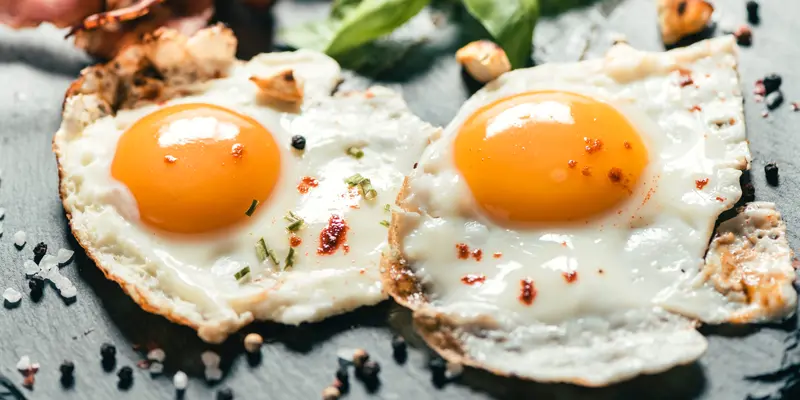
Ayurveda gives an explanation of different types of eggs in the classical texts. Ducks, poultry, and quail eggs are effectively used as medicine in various diseases like decreased sperm count, chronic cough, Tuberculosis, heart diseases, and more. Eggs are also said to improve growth and development in children.
Modern medicine explains that an egg has 9 essential fatty acids along with Omega-3 fatty acids. A large egg contains over six grams of protein. It has 4.5 grams of fat which is only 7 percent of the daily value. Only one-third (1.5) grams is saturated fat and 2 grams is mono-unsaturated fat. They contain, in varying amounts, almost every essential vitamin and mineral needed by humans as well as several other beneficial food components.
Though eggs are highly nutritious, it is heavy in nature according to Ayurveda. This heaviness makes them hard to digest. People with strong digestive power can definitely include eggs in their diet.
Read more: 7-Day Ayurvedic Breakfast Plan
Fish In Ayurveda
Ayurveda also has explanations and details on consuming fish.
Eating fish improves strength and helps in gaining weight. It is Vata pacifying in nature and can be consumed in diseases occurring due to aggravated Vata. It also increases Kapha, due to which fish is not advised for daily use.
Acharya Susruta, the ancient Ayurvedic author and father of surgery, explains in detail about the quality of fish residing in ponds, lakes, streams, and rivers. Ayurveda prefers small fish varieties over larger ones. Small fishes like anchovies are light for digestion, provide instant energy, are delicious, and pacify all three doshas.
Fish is a low-fat, high-quality protein. Fish is filled with Omega-3 fatty acids and vitamins such as D and B2 (riboflavin). The fish is rich in calcium and phosphorus and a great source of minerals, such as iron, zinc, iodine, magnesium, and potassium.
The American Heart Association recommends eating fish at least two times per week as part of a healthy diet. Fish is packed with protein, vitamins, and nutrients that can lower blood pressure and help reduce the risk of a heart attack or stroke.
Shellfish is one of the more common food allergies. This allergy usually is lifelong. Certain descriptions of allergic reactions to fish have been described in Ayurveda as well. Intake of prawns and milk together is considered virudh ahara (incompatible).
There are two groups of shellfish: crustacea (such as shrimp, crab, and lobster) and mollusks (such as clams, mussels, oysters, and scallops). Crustacea causes most shellfish reactions, and these tend to be severe. Shellfish can cause severe and potentially life-threatening allergic reactions (such as anaphylaxis). Allergic reactions can be unpredictable, and even very small amounts of shellfish can cause one.8
Ayurveda considers prawns to be the worst of fish varieties since it aggravates all three doshas.
Read more: What To Eat For Dinner According To Your Dosha (Ayurveda Dinner Ideas)
Health Tips For Meat Consumption
Keep in mind the following things when you consume meat.
- Do not consume meat daily. Instead have it moderately, and have more in the winter season when you have a strong digestive power.
- Keep in mind your digestive power and constitution while consuming meat. A Kapha-predominant person must consume less meat compared to a Vata-predominant person.
- If you consume meat, make sure you exercise to keep the body healthy and fit.
- Along with meat, include vegetables and grains in your diet. Make sure you receive all the necessary nutrients.
- Choose organic, hormone-free meat whenever possible.
- Choose quality over quantity. A meatball-sized portion of meat (1/4c) eaten daily with vegetables and grains is an appropriate amount that your body can process fully.
- According to Charaka, healthy and wholesome food, even if taken even in proper quantity, does not get properly digested when the individual is afflicted with grief, fear, anger, sorrow, excessive sleep and excessive vigil. Therefore, your mind matters.
- Food taken in proper quantity provides strength, vigor, and a good complexion and nurtures the health of the tissues. To live healthy, one must live in harmony with his surroundings and follow a diet suitable to one’s own bodily constitution.
Read more: Ayurvedic Cold Weather Diet + Lifestyle


0 Comments