

Today, we will learn about Brahmi benefits and why this powerful Ayurvedic herb has been valued for centuries. Known for its ability to enhance memory and reduce stress, Brahmi herb plays a key role in traditional wellness practices.
We will also explore its Ayurvedic uses, ideal dosages, and how it compares to a similar herb, Gotu Kola.
What is Brahmi?
Brahmi, also known botanically as Bacopa monnieri, is a very well-known Ayurvedic herb used to improve memory, concentration, and intelligence.
Brahmi is a Sanskrit word derived from the words brahma or brahman. According to Hindu mythology, brahma is the creator of the universe.
It is said that lord brahma is responsible for all creative forces in the world.
The word brahman in Hinduism connotes the highest universal principle (also called the ultimate reality). Brahmi literally means the energy/wisdom of Brahma.1
Indian pennywort, thyme-leafed gratiola, water hyssop, or herb of grace are some of the other common names for brahmi.
Brahmi herb has been used for centuries in the Ayurvedic system of medicine. Either by itself or with a combination of other herbs, brahmi has long been an important medicine in Ayurveda.
In renowned Ayurvedic medical texts like the Dravyaguna Vijnana (herbal pharmacology), brahmi has been categorized under medhya herbs.
Medhya herbs are used in Ayurveda as nootropics i.e. cognition enhancers to improve memory, intelligence, and other neurological functions.
In Ayurveda, brahmi has been described as having a wide variety of uses. In today’s blog, we will discuss them along with the various bacopa monnieri benefits.
Brahmi has also been extensively mentioned in the Ayurvedic medical texts Charaka Samhita and Sushruta Samhita. A few examples from these classical textbooks have been mentioned here.
Brahmi has been categorized under balya maha kashyaya, sangya sathapana maha kashyaya and praja sathapana maha kashayaya by renowned Ayurvedic scholars Charaka.
Balya maha kashyaya is a group of herbs that provide strength and immunity.2
Sangya sathappan maha kashayaya is a group of herbs that help in preventing unconsciousness i.e. improving alertness and influencing the quality of consciousness.3
Praja sathapana maha kashaya is a group of herbs that are helpful in stabilizing pregnancy.4
Brahmi herb is used in a wide variety of Ayurvedic formulations. Brahmi ghrita, brahmi oil, and brahmi powder are some of the commonly available preparations.
The freshly extracted juice of brahmi is also used. Brahmi is also available as capsules and syrups. In Ayurveda, brahmi has been described to have a wide variety of uses and brahmi benefits are immense.
Some other important Ayurvedic formulations containing brahmi are saraswat arishta, saraswata churna, and smriti sagar rasa.
Brahmi is not only a part of Ayurvedic formulations but it is also used in a variety of food products.
ADVERTISEMENT
There are various commonly available food products (depending on your location) including beverages and health drinks that contain brahmi as an ingredient.
Some beverages even have brahmi as the primary ingredient, while some have it mixed with fruits and other ingredients.
Besides these, brahmi granules are also available which can be taken after mixing with milk. Brahmi granules are available in various flavored forms as well.
Brahmi is also used as an ingredient in custard powders, health foods, jellies, biscuits, nutrition bars, and cereals.
So, now you know what is brahmi and what are different uses of brahmi are. Let’s dive deep into it but before that let us
Differences Between Brahmi and Gotu Kola
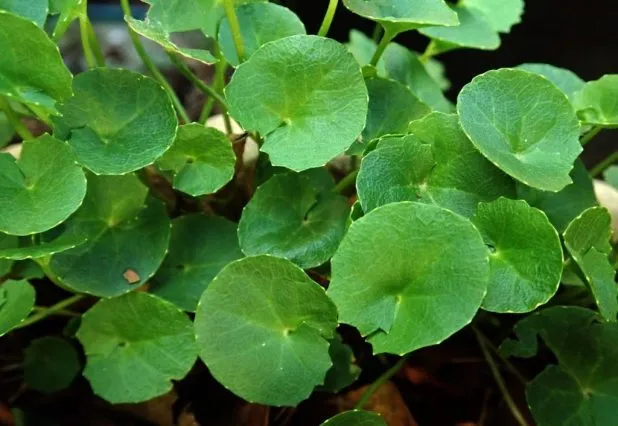
Gotu kola, another herb from popular Ayurvedic texts is also known as mandukaparni. Interestingly, it is mistakenly considered to be brahmi in the norther regions of India.
Many herbalists often mislabel gotu kola as brahmi but the plants are totally different. Gotu kola is Centella asiatica whereas brahmi is Bacopa monnieri.
The comparative phytochemistry, pharmacology, and therapeutic properties of these two herbs are also distinct.
The Ayurvedic Formulary of India has also clarified that brahmi is Bacopa monnieri and gotu kola or mandukaparni is Centella Asiatic. Classical Ayurvedic textbooks have also mentioned them as separate herbs.
However, just like brahmi, gotu kola is also categorized under the medhya (nootropic) category of herbs.
Gotu kola is mistakenly known as brahmi in some regions of the country because the literal meaning of brahmi in Hindi/Sanskrit is anything that increases intelligence, memory, and general cognition.
The reason these herbs are confused with each other is probably that both are used as nootropics (cognition enhancers).
Read More: Ayurveda on Gotu Kola: Its Benefits for Skin and Hair
What is Brahmi’s botanical description?
Bacopa monnieri is a small, soft, perennial, creeping, and non-aromatic herb.
It has numerous branches which particularly grow in wetlands and marshy places.
The plant can generally grow up to 6 inches in height.
However, it can grow up to 3 feet in height. Branches creep horizontally and cover the ground.
Brahmi’s leaves are small, oblong, and green in color. The leaves are coin-shaped and grow in clusters of two to three. The leaves are placed alternatively on the hairy stem. Its leaves are succulent in nature and are 4-6 mm thick.
The flowers are small and actinomorphic. Flowers are light pink bluish-white or light purple in color. Brahmi’s flower contains 4-5 petals. These flowers grow in the summer season and later on, fruit grows.
In India and other tropical countries, it grows naturally in wet soil, shallow water, and marshes. It grows naturally around wells, rivers, and ponds where water is regularly available.
Brahmi is also found as a weed in rice fields.
The herb can be found at elevations from sea level to altitudes of approximately 4000 feet.
It is also called the water aquarium plant because it grows in water. The propagation of plants is often achieved through cuttings.
Brahmi is an indigenous plant that is found throughout the country in the damp and marshy areas of tropical regions.
Brahmi is also found in India’s neighboring countries like Nepal, Sri Lanka, China, Taiwan, and Vietnam. It is also found in US states like Florida, Hawaii, and some other southern states where it can grow in damp conditions (by a pond or bog garden).
Brahmi herb can be grown hydroponically. Hydroponics is a method of growing plants without soil. Here, plants are grown using mineral nutrient solutions in a water solvent.
One of the benefits of brahmi is that you can grow it yourself!
Sanskrit Synonyms Of Brahmi With Meanings
Aindari: It is called aindari because it gives the body energy and power. It is also called aindari because it grows in ‘watery land’.5
Ayurvedic Properties of Brahmi
Take a look at some of the amazing properties of brahmi below6:
- Rasa or Taste: Tikta or bitter
- Guna or Qualities: Laghu or light
- Virya or Potency: Ushna or hot
- Vipaka or Taste Conversion After Digestion: Katu or pungent
- Prabhava or Special Effect: The prabhava of brahmi is medhya (cognition enhancement)
- Effect on Dosha: Bacopa monnieri is Kapha dosha shamak and Vata dosha shamak. It pacifies excessive Kapha and Vata dosha because of its ushna virya or hot potency.
- Parts Used: Panchanga or the whole plant.7
- Brahmi Dosage: Swarasa or freshly extracted juice 10-20 ml.7
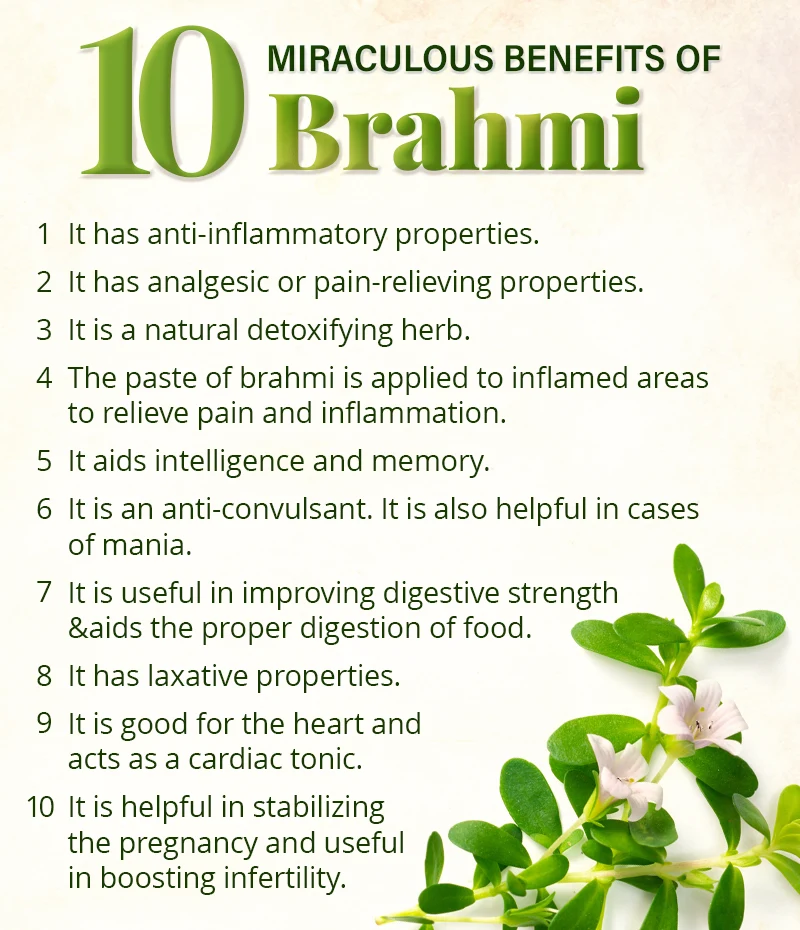
10 Benefits of Brahmi and Its Uses
Bioactive Constituents Of Bacopa Monnieri
Various phytochemical studies have shown that the main chemical constituents of brahmi are alkaloids brahmine, herpestine, nicotine, saponin, monierin, hersaponin.
Bacosides A1, A2, A3, and B, bacogenins A1 to A4, steroids triterpene, and bacosine. Apart from the Bacopa saponins A–F, three new triterpenoid glycosides, Bacopasides III–V have also been shown.
Saponins are the main active constituents of extract of brahmi and are responsible for most of its pharmacological actions.9
The active ingredients of extract of Bacopa monnieri are enlisted below in table.9
| Chemical groups | Contents |
| Saponins | Bacoside A, bacoside B, bacopasaponins, D-mannitol, acid A, monnierin |
| Flavonoids | Apigenin, luteonin |
| Alkaloids | Brahmine, herpestine, hydrocotyline |
| Glycosides | Asiaticoside, thanakunicide |
| Phytochemicals | Betulinic acid, betulic acid, wogonin, oroxindin, stigmastarol, β-sitosterol |
| Sapogenin | Jujubacogenin, pseudojujubacogenin |
| Other constituents | Brahmic acid, brahamoside, brahminoside, isobrahmic acid |
Nutrient Composition Of Brahmi
| Component | Amount (per 100 gram) 10 |
| Moisture | 88.4 gram |
| Protein | 2.1 gram |
| Fat | 0.6 gram |
| Carbohydrates | 5.9 gram |
| Crude fiber | 1.05 gram |
| Ash | 1.9 gram |
| Calcium | 202 mg |
| Phosphorus | 16 mg |
| Ascorbic acid (Vitamin C) | 63 mg |
| Nicotinic acid | 0.3 mg |
| Iron | 7.8 mg |
| Energy | 38 cal |
In general, brahmi is well tolerated by most individuals. While brahmi has its own uses and benefits, the most common brahmi side effect seen in some people is gastrointestinal distress. The main symptoms of gastrointestinal distress include nausea, vomiting, and diarrhea.
If you want to take brahmi for its above-mentioned benefits, consult a qualified Ayurvedic /practitioner or general physician first.





I am certain this will become a very famous blog soon due to the quality of its content. Kudos to the entire team.
Thank you so much for your kind words and encouragement 🌿🙏 We’re thrilled to hear that you appreciate the content, and your support truly motivates us to keep sharing more!