

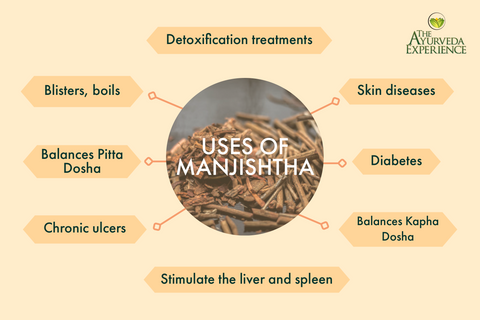
Manjistha is one among the prime herbs used in blood, liver and skin detoxification treatments. Its root is extensively used in many skin diseases medicines of Ayurveda. It is known as Indian Madder in English. It is used in many oral Ayurveda medicines and in Ayurveda oils for skin conditions as well.
Botanical name – Rubia cordifolia Linn.
Family – Rubiaceae
Indian madder or Manjeeth is used in textile industry as a natural red coloring agent. It is used in processing arecanut, so as to increase the astringent taste of the betel nut and to increase the shelf life.
Among the skin diseases, Manjistha is highly effective in the treatment of eczema, Tinea infection and dermatitis.
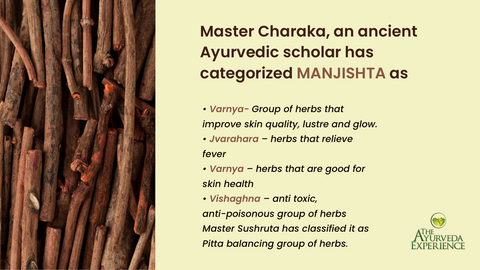
Master Charaka, an ancient Ayurvedic scholar has categorized Manjistha as,
- Varnya– Group of herbs that improve skin quality, lustre and glow.
- Jvarahara – herbs that relieve fever
- Varnya – herbs that are good for skin health
- Vishaghna – anti toxic, anti-poisonous group of herbs
Master Sushruta has classified it as Pitta balancing group of herbs.
This plant is known for its blood purifying, skin glow enhancing effect, healing properties and to stimulate the liver and spleen. In Chinese medicine also it is used as an anti-toxin herb.
The stem and roots are the used part.
Qualities and functions of Manjistha
- Ayurveda describes that Manjistha has bitter, astringent and mild sweet tastes.
- and astringent tastes. It has hot potency.
- Due to bitter, astringent and sweet tastes, it balances Pitta Dosha. Because it mitigates Pitta, it is useful in diseases of the tissues where Pitta is involved, such as skin (wounds, skin diseases) and eyes.
- Due to hot potency, it balances Kapha Dosha, hence useful in diabetes, obesity, and skin diseases associated with itching such as allergic dermatitis.
- The plant contains yellow gencoside, mangistin, garancin, algerin, zenthgin, salt contents and rich amount of starch.
Read More: Manjistha: Lymph Purifier, Ayurvedic Blood + Toxin Cleanser
Health benefits of Manjistha as explained in Ayurveda
Svarakrut – improves voice – Singers have the habit of chewing a small piece of Manjistha, ahead of their performance. Its herbal decoction or cold infusion (method of preparation, explained below) is added with honey and used for gargling to improve the voice.
Varnakrut – improves skin health
Useful in the treatment of:
Visha – toxic conditions, poisoning – especially insect and rodent bites.
Shotha – inflammatory conditions – Methanolic extracts of Rubia cordifolia are useful in reducing the inflammation.
Yoniruk – gynecological disorders – Manjistha herbal tea is used as vaginal douche to cleanse the cervix and to clear infections.
Karnaruk – ear pain – An herbal oil prepared with this herb is used as ear drops to relieve pain and infection
Akshiruk – eye pain – Because it can balance down Pitta, Manjistha is used orally in treating eye disorders
Raktatisara – Ulcerative colitis– Because of Pitta balancing nature, Manjistha is frequently used orally and also in the form of decoction enema, in the treatment of ulcerative colitis.
Kushta – skin diseases – Its oil and herbal teas are used externally and orally.
Manjistha is also used for the treatment of
Herpes, non-healing wounds associated with diabetes, deep sinuses, fistula, diabetes and urinary tract infections.
Home remedies with Manjistha
ADVERTISEMENT
Pimples, dark spots
Manjistha fine paste for pimples and dark spots:
Manjistha stem or roots fine powder is rubbed well with water and applied over the skin lesions of pimples and dark spots. It is a natural complexion enhancer. Fresh roots can be used for this purpose. Or fine powder of dry root is added with water to prepare paste.
Chronic ulcers
Manjistha decoction in washing the chronic ulcers:
- 1 tablespoon of Manjistha is added with 2 cups of water, taken in a wide mouthed vessel. It is boiled in mild fire till the water quantity decreases to a quarter. It is then filtered and administered. This decoction is used to wash the wounds in case of chronic wounds, non-healing ulcers etc. It is also administered orally.
- In insect bite wounds, this is used to reduce inflammation and pain by the folk healers.
Blisters, boils
Manjistha cold infusion in blisters and summer boils:
20-30 gram of coarse powder is soaked in 200-300 ml of water and kept overnight. This is macerated well and consumed early morning. In burning of the body (summer season and in menopausal period), blisters and boils this is very effective. This remedy acts as a coolant drink. In cases of fever, it is administered to reduce the body temperature and burning sensation.
Skin diseases
Manjistha and Sariva (Hemidesmus indicus) decoction in skin diseases:
Both these herbs are well known blood purifiers. Their combination if made into decoction and taken it cures several skin diseases very effectively.
Burns
Manjistha herbal ghee and oil for burns:
- Manjistha , tender leaves of Teak wood and red sandalwood are taken in equal quantity and ghee or oil is processed as per the classical method of cooking the oil/ghee. This oil or ghee is used to apply over the burns and scalds. It pacifies burning, pain and reduces the chances of boils and there after caused skin discoloration.
- Rodent bite: Master Vagbhata explains that a paste is made with soot of the kitchen (very fine powder of charcoal), Manjistha , fine powder of turmeric and rock salt. This is applied over the rodent bite site. It makes the slough collected over the bite site to fall off, reduces swelling and pain and quickens the process of wound healing.
- A paste remedy is prepared long pepper, Manjistha , turmeric and Chebulic Myrobalan is applied over the organ bitten by poisonous spider.
Read More: Manjistha Tea Benefits, How To Take Manjistha, Side Effects, Contraindications
General dose of Manjistha
Powder – 1 – 3 grams
Kashaya – 20 – 50 ml in divided doses or as directed by Ayurveda doctor
Ayurveda medicines
Ayurveda medicines with Manjistha :
- Maha Manjishtadi Kashaya – used for skin diseases and for blood purification.
- Kumkumadi oil- Famous oil for skin glow and quality improvement
- Maharaja Prasarini Tailam - A peculiar oil used in neurological conditions, administered orally and also externally (massage).
- Panchatikta Guggulu Ghrita - A ghee used in abscess, sinus treatment etc.
Side effects
There are no known side effects. It can be used in children and lactating mothers in small quantities. Seek medical guidance for its use during pregnancy.





0 Comments