

You might be wondering why I talk about the quality of mind all the time when mostly, it’s our bodies that we focus on being healthy and balanced. Because! If the mind is not healthy the body won’t be either. It starts with the mind first!
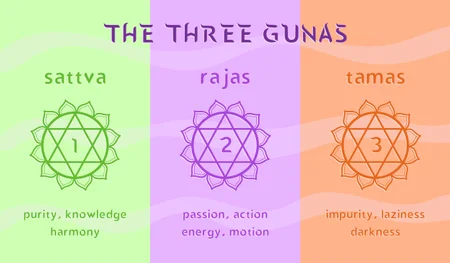
In addition to the three doshas (Vata, Pitta, Kapha), there are three qualities of the mind or trigunas. “Guna” means quality, so we can think of them as energies, qualities, or states of mind. The trigunas are sattva, rajas, and tamas (this Ayurveda thing keeps getting deeper, doesn’t it?).
Sattva is pure harmony and does not cause disease. However, rajas and tamas can cause disease if imbalanced.
Sattvic Quality of Mind
Intelligence, harmony, purity of thought and action, balance, generosity, stability. Inward focus. Creates peace, unconditional happiness, love and contentment. We all need more sattva! When sattva—the quality of clarity and balance—prevails in the mind, it brings a sense of calm, inner clarity, and virtuous behavior. To support this state, Ayurveda recommends sattvic foods—those that are light, pure, and freshly prepared. Such meals are best consumed soon after cooking, as their life force (prana) begins to fade the longer they sit out.
Ayurveda views eating as much more than a physical act—it’s an experience that affects the body, mind, and emotions. Your overall wellness is shaped not just by what you eat, but also by when, where, why, and how you eat it. Food that aligns with your unique constitution (prakriti) and current state of health can help restore balance and promote a healthy mind. The choices you make at mealtimes can influence your mood, energy levels, and emotional stability—making mindful eating a cornerstone of holistic health.
Rajasic Quality of Mind
Rajas refers to transformation, active, dominance, duty, power, prestige, attachment to the senses and desires, living through the ego, or outward focus. It also helps you achieve your goals. Yet, it is attached to the outcome of your goals, which in the end causes suffering because one can never be satisfied. To put it out simply, most of us live in the rajas state of being!
Tamasic Quality of Mind
Tamas refers to the qualities of darkness, ignorance, close mindedness, lack of awareness, obstruction, decay, and/or downward focus. In the mind, it causes fear, depression, dullness, heaviness.
The goal is to move up the ladder to have more sattvic qualities and a healthy mind. However, if we were all solely sattvic, we’d just be sitting around happy all the time, but nothing would get done. So, there is a balance. Even tamas has its place when something “dies” or comes to an end.
Diets That Shape Healthy Mind & Emotions

The Sattvic Diet
A sattvic diet is rooted in mindfulness and supports clarity, emotional balance, and vitality. It includes fresh, wholesome foods that are rich in prana—the life energy present in nature. Think of seasonal fruits and vegetables, fresh juices, herbal infusions, whole grains, nuts, honey, jaggery, cow’s milk, and sprouts. These foods are ideally prepared and eaten fresh, as their life force begins to decline with time. When sattva is dominant in one’s life, the mind tends to be calm, clear, and aligned with higher values.
The Tamasic Diet
A tamasic diet dulls the senses and weighs down the mind. It includes stale, overcooked, processed, or preserved items like packaged meals, deep-fried snacks, frozen foods, heavily processed meats, and alcohol. Regularly consuming such foods can contribute to lethargy, confusion, and a lack of motivation. Even how food is prepared matters—microwaving or deep-frying can strip it of its vitality, making it energetically dense and tamasic. Choosing fresh, naturally cooked meals helps uplift the mind and body alike.
The Rajasic Diet
A rajasic diet is stimulating and often heavy on spices, oils, and strong flavors. It typically includes items like meat, fish, eggs, sprout-free legumes, canned foods, pickles, garlic, onions, vinegar, white rice, sugary treats, and rich dairy like sour cream and cheese. These foods can fuel ambition, restlessness, and activity—but when consumed in excess, they may disturb mental peace and trigger emotional instability. Rajas feeds drive and motion, but without balance, it can lead to burnout and anxiety.1
Mastering a Healthy Mind with Ayurvedic Psychotherapy

Ayurveda offers a unique approach to mental well-being through a psycho-spiritual method known as Sattvavajaya Chikitsa2,3. This therapeutic practice focuses on guiding the mind toward balance by replacing distressing thoughts with those that uplift and heal. Central to this approach is Pratipaksha Bhavana—the conscious cultivation of positive thoughts to counteract negative emotions. By doing so, it aims to achieve Mano Nigraha, or mental restraint, encouraging the mind to let go of thoughts and influences that are harmful or unwholesome (Ahita Artha).
This form of therapy doesn’t just address surface-level symptoms—it works at a deeper level by incorporating techniques like Ashtanga Yoga, which promote inner stability, clarity, and emotional strength. The term Sattvavajaya itself comes from Sanskrit: Sattva, as mentioned before, refers to the mind or consciousness, and avajaya means mastery or control—together signifying mastery over the mind.
The ancient Ayurvedic sage Charaka emphasized the importance of mind control in maintaining mental health. He observed that the mind naturally gravitates toward troubling or unhealthy thoughts, which, if left unchecked, can disrupt emotional balance. Sattvavajaya addresses this by guiding individuals to consciously shift their mental focus—turning anger into compassion, fear into courage, and resentment into forgiveness. This intentional redirection not only strengthens emotional resilience but also fosters a deep sense of inner peace.



0 Comments