

Let’s see how we can implement Ayurvedic Wisdom into practice reaping all the benefits we might not get by just following the modern concept of exercise alone. The modern concept of a daily exercise routine is based on the movement of muscles and muscle groups, extensor and flexor compartments, and toning and synchronizing the movements of the two. It also emphasizes the development of core muscle groups and skills needed for a particular sport. In aerobic exercise, emphasis is given to reaching the target heart rate.
On the other hand, Ayurveda believes that every individual is different, it’s best to exercise until you do not get out of breath and have to mouth breathe. This is your Bal-Ardha or half strength. You have to stop at this point and start again later after a period of rest. Slowly, this threshold level increases. This way while breathing deeply through your nose you are allowing the ‘Prana’ to reach the remotest parts of the lungs, inducing a sense of relaxation at the level of body tissues.
If you push the body too much you end up taking short breaths from the mouth. Ayurveda explains that this generates stress in the body tissues (every cell of the body has a mind of its own as per Vedic Philosophy).
Ayurveda Suggests a Daily Exercise Routine
- Breathing exercises to increase the flow of Prana (Life Force).
- Meditation or deep relaxation creates a balance between the internal self & external world and allows the body to repair and the mind to attain happiness and ultimately a state of permanent bliss.
- Yoga Poses (yoga though is a complete science of Body, Mind & Spirit at a superficial level the use of Yoga postures is very beneficial to enhance mind-body coordination).
- An appropriate Physical Activity (per your Dosha)
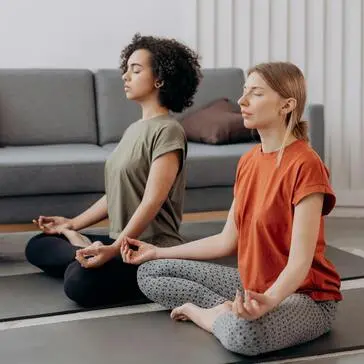
Such an exercise routine includes a workout that affects not only your body but has a positive influence on your mind, emotions, senses, and spirit. The benefits of Vyayama (exercise) are achieved as you focus on your chosen activity with awareness of your breathing, physical responses, and sense of well-being. When you exercise according to Ayurvedic Tradition, your energy and vitality are enhanced by the appropriate demands placed on your body, and you are left with a feeling of Happiness.
Ayurveda tells us that perspiration on the forehead is one sign that we have had enough exercise. Perspiration on the rest of the body is bound to happen and is fine, but once it starts appearing on the forehead, we should stop.
Ayurveda also advises stopping exercising when we feel we have reached about 50-75% of our capacity. We don’t want to wear ourselves out. When we do this we can naturally increase our stamina over time. we should never exert ourselves so much that we have to gasp for breath.
The amount of exercise also depends upon the climate. In hot weather and in summer in general, the exercise should be lighter. It should not be done immediately after food on a completely empty stomach or when we are feeling sick or feeling weak.
Read more: Exercises: Guidelines to Follow
Harmful effects of excessive Exercise
If a daily exercise routine is followed excessively, it causes tiredness, exhaustion, depletion of body fluids and body tissues, excessive thirst, vitiation of blood, breathing difficulties, cough, fever, giddiness & vomiting/nausea.
Benefits of Exercise
Ayurveda explains many benefits of exercise when done properly. They are:
- Exercise nourishes the body, improves the luster and shape of the body
- It brings about lightness in the body and removes laziness
- It increases stamina to do both physical and mental work
- It increases the strength and stability of the body
- It increases the capacity to bear stresses like cold & heat, and fatigue
- It balances the doshas
- It helps make digestion stronger
- It helps with overall health
- Exercise cures twenty types of Kapha diseases like anorexia, drowsiness, laziness, excessive sleep, heaviness of the body, sweet taste in the mouth, indigestion, hardening of the arteries & obesity
- Exercise is the essential component of the treatment of diabetes mellitus and obesity as per Ayurvedic texts
Read more: 10 Unbelievably Easy Yoga Poses To Help Relieve Stress & Anxiety


0 Comments